skip to main |
skip to sidebar
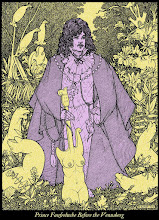
A reiteration of the Snarkic Galdor … a type of verse-charm first overheard by the poet Lewis Carroll whilst sipping his tea and mentally searching for rhymes in the commons room of Christ Church College in the depths of the latter half of the 19th century. No doubt Carroll was puzzled by this sudden outbreak of cryptoskáldic fervour in what was then a bastion of High Church Anglicanism but he was a discreet man and kept his thoughts to himself.However, I am congenitally incapable of keeping any thoughts to myself! At this very moment I am mentally whirling along transient nodes of thought careening through a cosmic vapor of invention, as the infamous Hedly Lamar once pensed aloud to the uncomprehending Slim Pickens.Unlike Slim Pickens, gentle reader, you will easily grasp the essence of my thoughts, which I’ve illustrated above. The Snarkic Galdor is baited, literally, with the tempting person of the Baker himself! Lured by his smile and a bar of soap, the unsuspecting Snark will venture underneath the requisite giant thimble to be trapped there by the quick action of the Baker’s Fellows!The Baker’s transient nodes of thought on the matter can only be guessed at. However, thanks to the learned Adam Roberts’ ingeniously cosmic vapors of invention, we now know that the Baker’s earlier polylingual attempts at communication with his fellow B-Boyz were simply an observation that Humanorum hetaeria es auto (you are yourself the brotherhood of all men). His comrades have taken this generous, fraternal gesture of self-sacrifice on the Baker’s part as carte blanche to proffer him up as living Snark-Bait.This business of offering oneself up as a bait for Evil must inevitably occupy the whirling, transient thought-nodes of anyone enjoying his tiffin at the aptly-named Christ Church College. Perhaps, as Carroll munched his bread and butter sandwiches and plotted his anapests, he was entertaining first, second or even third thoughts about his own personal Boojums … or perhaps he was merely biding his time till the invention of the talking-type-wireless with which the ubiquitious Slim Pickens would finally set all of his religious doubts to rest!
Attention bibliophiles! Let publishers know that illustrated adult titles are not only a noble tradition dating back to ancient Egypt but also cool to look at … learn more about or even join my (quixotic) campaign to revive the genre of #BooksWithPix here.
We have already nibbled upon — and spurned! — Beatrice Hatch’s assertion that Lewis Carroll had told her that the word Snark was a portmanteau of Snail and Shark. The etymology of the Snark is an entire Hunt unto itself but it seems that we are running perilously low on bullets, tinned goods and scotch-soaked mosquito netting or so my faithful shikaris tell me … we had better return to civilization, such as it is, and seek our Snark indoors … such as these Snark Hunters pictured above are doing.Please observe that these Hunters are relying solely upon their finely-tuned instincts to track down their perilous prey and as usual, everything’s become a hopeless jumble! The afore-mentioned Beatrice Hatch’s linguistic brain-crumbs have joined in an unholy alliance with the semiographic cupcakes of the Belgian pâtissier (and chronophobe) René Magritte to create a novel yet frothy confection! Of course, such half-baked baked-goods would be incomplete without some of that double-plus-good explanatory frosting which the Critics love so; I append an explanatory (and thoroughly plagiarized) morsel here:"I decided to paint the image of a shark . . . In order for its mystery to be evoked, another immediately familiar image without mystery — the image of a snail — was joined."
Well, there you have it: an Indo-Germanic-Belgo-Anglo-Saxon layer cake of ink and words … I call it Beatrice’s Revenge, for it’s a rather heterogenous and unsettling dish best served cold, perhaps as an after-dinner dessert? Of course, Lewis Carroll’s original photographic bonbon of Miss Hatch was also a bit cloying but certain artists will always indulge their sweet-tooth!
There comes a time when even poets such as the Talented Mister Carroll draw a blank, as the saying goes. Yet such deficiencies seem to have not bothered him for long; he simply brewed up a fresh pot of tea, chewed reflectively upon his quid of paan and sooner or later, he would come up with the requisite anapests to fend off the Boojums at his door.
However, when an ink-slinging wretch such as I draws a blank, adverse professional consequences can result. Drawing a blank may be suitable behavior for those blessed artistes who frolic in the Elysian Fields of MOMA or the Tate but for us illustrative hacks bent over our drawing boards in the sweaty back-forty of Dante’s Inferno (Circle 8, Subsection 5, Barrators and Flatulants) such antics are the stuff of which bankruptcies are made of.
When deadlines press and the ol’ brainbox is running on fumes, remember the scuola metafisica’s dictum to draw only that which cannot be seen. The main thing is to keep one's pen busy, just bash on regardless and find something unseen to draw … or at least unseen by the average reader.
These headless anapests of Lewis Carroll rollick onwards in their frolicksome procession and who are we to deny their sonic allure? Of course, the essence of an anapest is the idea of a reversal and what better expresses that idea than the sudden realization that one is speaking in a language that no one understands? The unfortunate Baker is literally going backwards as the sense of what he says is instantly translated into nonsense by his puzzled auditors.Snarkologists call this sort of thing the Snarkosocratic Method, a kind of dialectic in which a question is responded to as though it were absolute nonsense. This in turn forces the questioner to endlessly repeat himself until his baffled auditors lose interest and finally go away.Left alone in his splendidly impenetrable semiolinguistic Fortress of Solitude, the Baker is now free to concentrate his intellectual powers upon himself. Toying with the building-blocks of language and meaning, he will arrive at some sort of Answer to Life, the Universe and Everything in It … or perhaps not, there's no difference, really.
False pretenses are the bane of modern life or so I’m told. Although Lewis Carroll seems to have composed an entire poem devolving entirely from the concept of false pretenses and all the semiotic and logical heartache they can inflict upon humanity, in our more louche age the concept of false pretenses has inspired instead a steady diet of policiers, bodice-ripping Mills & Boons and true-life confessional serial-killer-self-help-vademeca.
Very well, let the masses have their sensationalist Lewis Carroll, their police gazette Hunting of the Snark! If it’s murder and false pretenses they want, let ‘em have it!The heart of the problem, as I saw it, was to produce a drawing with a maximum of false pretensions and a minimum of actual labor. My eyes fell upon a tattered copy of a magazine, a well-known NYC magazine whose pages lauded a certain artist specialized in the art of portraiture, whose devotion to their practice (are they also dentists?) was such that they could not bear to paint more than one face, over and over, varying only the sitter’s name but never the actual picture. Gosh! Throwing caution to the winds, I brushed aside my idly gyrating Assamese nautch girl, recklessly purchased an entire sheet of second-grade-fresh drafting vellum and pushed another quarter into the meter of my steam-driven pen! Working without respite, I labored to flesh out the Baker’s criminal pretense, multiplying his crypto-Carrollian visage seven-fold!Huzzah for the critics! Huzzah for every artist who labors more over their bar tab than their drawing board! In a world of false pretenses, who is the menaced assassin and who is the menacing victim now? Look out, New York art-wallahs, here comes a real maverick!
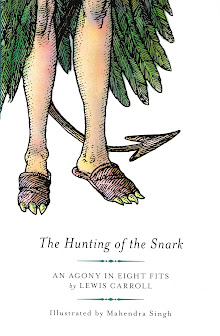
It's been a bit of a hiatus since my last posting, but in light of the current situation, I think it's time to resume my commentary upon my GN version of The Hunting of the Snark (available from Melville House, click on cover icon to the right) … when the going gets weird, the weird turn pro, as both Hunter Thompson and Lewis Carroll knew all too well!
A strange brew: a pastoral melancholy of the gods resurgent, a fête galant of the ancien regime, the reveries of Lewis Carroll and an obscure illustrator.The Fellowship of the Snark has succumbed to the most delicious ennui, the most languid douceur possible … it is impossible, amidst the heady scent of perfumed bowers and amorous glances, to even speak that hateful word Boojum … far easier for the Boots to nibble on his ladylove’s niobic neck, far easier for the Butcher to lead the gallant company of andromachean mannequins and embryonic homunculi down the verdant lawn towards the wondrous, gilded barge whose pilot, the Bellman, will steer them to the sanctuary of Cythera, that isle of enchantment where all things distasteful softly and suddenly abrade away into their constituent semioglyphs …
I submit for your perusal the word uffish in the above lines. Lewis Carroll explained it thus: "it (uffish) seemed to suggest a state of mind when the voice is gruffish, the manner roughish, and the temper huffish."This is nothing more than a clever plan (hatched, no doubt, in some "scenic" bathing machine) to explain the Origin of Language in the Human Species by means of the Clochetic Rule-of-Three!Simply put, the learned Mister Carroll was pointing out that whatever we tell one another three times eventually does become true, that is to say, we need look no further for any linguistic First Cause than the simple observation that long ago, certain sounds became words through mere repetition.
We might even say that sound becomes symbol through repetition, or even better, chaos becomes order through repetition. So much for the Meaning of Life, the Universe and Everything in It! Mister Carroll seems to have whittled it all down to a proper size, easily digestible and suitable for the masses.Of course, there are always certain idle loafers lounging in every philosophical woodpile, hairshirt-wallahs such as Ludwig Wittgenstein, who dismissed the linguistic and logical implications of Carroll’s Clochetic Rule-of-Three by sniffing (in German, no less) that it was as if “someone were to buy several copies of the morning paper to assure himself that what it said was true.”To which we reply: What rubbish! Quelle bêtise! Was für ein Quatsch!____________________NB. The plethora of doors in the above stanzel are the doors of perception, which, if cleansed, would allow everything to appear to the Snark concealed behind each of ‘em as it truly is — infinite! You do realize, don't you, that to these concealed Snarks, we are the concealed infinity behind their doors?
After a successful hunting, one is always left with the remains of the dead, even in Lewis Carroll’s genteel, literary world. In this, the frontispiece to Fit the Fourth, we see the remains of a particularly jolly hunting, stuffed and mounted upon the wall of a certain someone’s hunting lodge.
The Bellman looks particularly splendid and lifelike and for those of you who keep track of such matters, the Snark-is-Eye Leitmotif can be discerned through the looking glass.Look, look there, at that uppermost head in the middle … why, it’s the Boots-cum-Charles-Darwin … what grotesque sense of humor put him there? Was it one of those Literary Darwinists? — they’re all the rage now! Lurking behind every poem and novel and feuilleton, we find them ascribing the most salacious evolutionary motives to every author — and yes, every reader! Oh the times, oh, the customs, when the reader is being read, the author is being authored, and yes … the hunter is being hunted!I could go on like this for some time now but all this thinking is a bit taxing; I‘d rather be outside in the fresh winter air, grouse-hunting from a helicopter or seal-clubbing till midnight or whatever it is that we must do for sport in these oddly unimaginative antinomian times.
The last, fateful words of the Baker-AKA-Lewis-Carroll before he is obliterated by the icy glare of the Snark-As-Eye lurking in the wardrobe.This whole Boojum business is what literary wallahs like to call a Catharsis, a purging and expelling of unsettling emotions, resulting in a post-Boojum state of relaxation, gleaming white teeth and little or no underarm perspiration.
In this state of enlightenment all of one’s troubles softly and suddenly vanish away and one is left with only the minty fresh after-taste of … Boojum-Orientalism!Boojum-Orientalism is fundamentally a political doctrine willed over the Boojum because the Boojum is weaker than the Baker, a doctrine which elides the Boojum’s difference with its weakness. . . . as a cultural apparatus Boojum-Orientalism is all aggression, activity, judgment, will-to-truth, and knowledge … the whole point about this system is not that it is a misrepresentation of some Boojumistic essence — in which I do not for a moment believe — but that it operates as representations usually do, for a purpose, according to a tendency, in a specific historical, intellectual, and even economic setting …Yes, dear reader, aided only by my trusty power-packed pen and buckets of second-grade-fresh ink, I have created a Boojum-ridden Baker casting aside the dehumanizing gaze of the oppressive Victorian Boojum … (pauses for breath) …
… and a resurgent postcolonial Boojum reasserting his Snarkitude by rejecting the anapestic snares of the oppressive Victorian Snark Hunter … (dabs brow with gin-soaked compresses) …
… ergo, hurrah for the disappearance of the Author-Function! Hurrah for the justified tyranny of the Reader-Boojum! Hurrah for everybody! … (fans gyrating nautch girl with freshly minted rupees earned from Snark royalties).
Perfect Christmas or Unbirthday Gift
for the Carrollian Nutter in Every Family—Original Snark Art!
Original art from my Hunting of the Snark Graphic Novel (Melville House) for sale, 8”x13”, pen & ink on Denril (synthetic vellum) drawings of the finest Nonsense money can buy. DM me for prices and art list.
The last, fateful words of the Baker-AKA-Lewis-Carroll before he is smothered by the inky depths of the night, suffocated by the relentless Amorous Gigantism of Inanimate Things, transfixed by the icy glare of the Snark-Is-Eye lurking in the wardrobe — obliterated, in short, by his memories of the future!This whole Boojum business is what literary types like to call Catharsis, a purging and expelling of unsettling emotions, a process which results in a post-Boojum state of relaxation, mental ease, gleaming white teeth and little or no underarm perspiration. In this state of enlightenment all of one’s troubles softly and suddenly vanish away and one is left with only the minty fresh after-taste of … Boojum-Orientalism!Boojum-Orientalism is fundamentally a political doctrine willed over the Boojum because the Boojum is weaker than the Baker, a doctrine which elides the Boojum’s difference with its weakness. . . . as a cultural apparatus Boojum-Orientalism is all aggression, activity, judgment, will-to-truth, and knowledge … the whole point about this system is not that it is a misrepresentation of some Boojumistic essence — in which I do not for a moment believe — but that it operates as representations usually do, for a purpose, according to a tendency, in a specific historical, intellectual, and even economic setting …All hail the post-truth Second-Grade-Fresh-New-World-Order! Aided only by my trusty giant power-packed pen and buckets of thick, reheated cafeteria-style ink, I have deconstructed a Boojum-ridden, prostrate Baker into a resurgent postcolonial Boojum reasserting his alienated Snarkhood and casting aside the dehumanizing typology of the oppressive Victorian bourgeois Snark Hunter … (pauses for breath) …… until that time when that fickle Wheel of Fate turns again and allows a resurgent postcolonial Baker to reassert his alienated manhood and cast aside the dehumanizing typology of the oppressive Victorian bourgeois Boojum … (dabs brow with gin-soaked compresses) …… hurrah for the disappearance of the Author-Function! Hurrah for the justified tyranny of the Reader-Boojum! Hurrah for everybody!
How well Lewis Carroll understood the human condition! The difference between nonsense and tragedy is slim at best. Observe the above pictolinguistic Snarkglyph.
A certain baker, a maker of cakes and pastries, suffers from nightmares — probably the result of over-eating baked goods — which he combats with healthful salads and the nocturnal illumination of phosphorus matches. So far, so good, an eminently plausible scenario without the least taste of Nonsense about it. In fact, it is a commendably sober and salubrious cautionary verse upon the dangers of gluttony!And yet …These nocturnal adversaries of which our pistorian hero complains so mightily, these things that go bump in the night, these incubi, night hags and other mares that sit upon one’s chest and pose so stylishly for certain other artists, well, that’s all very well for the likes of the Talented Mister Fuseli, but here at Chez Snark we have simpler tastes — economy is our watchword! Even nightmares cost time and money! Let Messers Ernst and Holiday squander jeroboams of ink and hogsheads of paper upon their champagne-soaked renditions of the Baker’s Dream of the Snark — I cannot!With a meager drop or two of ink (2nd-grade-fresh, which makes my throat hurt so) and a few scraps of pentimenti (still reeking of garlic) I lie upon my tatty charpoy, with both pen and Assamese nautch-girl in my feeble hand and draw, as best as I can, the simple rudiments of the Baker’s Nightmare, that grim Adversary with which he struggles night after night.I ink a hard-won fork here, pencil in a desperately-needed matchstick there … the simple yet telling domestic detail of the wardrobe drawing nearer … render the Baker’s tear-stained, tattered leaf of Boston lettuce with which he keeps at bay the nocturnal chill … perhaps I even shed a tear into my tumbler of single-malt as I labor but no matter (no one can hear you weep in a modern, soundproofed garret anyway) … for that is the task I have taken upon myself, to draw things just as I see ‘em … and that is the nature of real Tragedy! — to engage with the Snark, every night and every day — on an illustrator's wages!
Gosh! This Baker/Lewis-Carroll-wallah* really does go on and on about Boojums. Of course, we all know how unwelcome they are and what havoc they can wreak on priceless family heirlooms like forks and hope, but methinks the Baker doth protest too much!
Yes, yes, yes, we’ve heard all of this before, a Boojum is a dreadful thing to contemplate, a Boojum fluoridated my drinking water and a Boojum tampered with my automobile’s brakes … but has the Baker ever gone mano a mano with a teenager? Has the Baker any idea what it is to roll up one’s sleeves and decervellage an American atheist? Has the Baker never crossed swords with a sharp-witted Englishman forced to squander his life and considerable talents as a mere maths tutor whilst blathering absolute nonsense to his young, boojum-like charges?
As for me, pshaw to all that! Yeah, mister, I’m a tough guy! I snap my inky fingers at ‘em, these pesky Boojums, they are but a trifle compared to coming up with some nice, snappy artwork for each and every line of The Hunting of the Snark … week after week … year after year … stanza after stanza … panel after panel … oh, god, it is this, it is this that I dread!
______________
*The Baker, whom we have conclusively demonstrated to be a doppelganger of Lewis Carroll, has spent several stanzels wringing his hands in a semi-subjunctive funk over the menace of Boojums. He sees Boojums in his salad, he sees Boojums in his railway carriage, he sees ‘em in his soap dish and he sees ‘em in his sewing kit. Oddly enough, the one place where the Baker never sees Boojums is in the here and now and it is this very suspense which oppresses our souls! Suspense and paranoia, the perfect Victorian bogeymen, nay, Boojums! It was Lewis Carroll’s master stroke to introduce paranoia, dread, fear and loathing into English nonsense verse, into the very inner sanctum of Jolly Olde Escapism, rather like Brexit or Teresa May dancing to ABBA but more so.
The crossing of international frontiers whilst engaged in the hot pursuit of a Snark is no excuse for scofflawyery or other antisocialism. We see here a young Surrey fellaheen, a Baker-disguised-as-Lewis-Carroll by trade, who is preparing his claim for refugee status on the grounds of Boojum persecution.
Rendered supine by his well-documented apprehension of meeting a Boojum through no fault of his own, he remains a-bed to conserve precious forensic evidence, ie., involuntary dairy-product substitution of a major organ. His parents bid him a tearful, wooden goodbye. His uncle, a Major General doubling in the role of psychopomp-cum-coyote (thus saving this artist considerable labor), carefully peruses a Customs and Border Protection Declaration Form …1. Declare all fetishes, such as smiles, soap, forks, etc., that you might have on your person for the purpose of hunting Snarks. Please have them unpacked and ready for inspection upon your arrival. The time for observation is limited and we mustn’t hold up others!
2. Notify the authorities if you are approached by anyone offering to distort the relative proportions of your surroundings. Any illicit trafficking in the amorous gigantism of the inanimate world, whether voluntary or not, may cause permanent semiotic confusion.
3. Please stay in line. Running into another line, or enjambment, might cause injury, disfigurement or even loss of life and limb. All lines should be end-stopped and masculine rhymed as befits true English nonsense.And to where is our Baker emigrating, you might ask? Perhaps, like the late, great Hedly Lamarr, he is fleeing this poem for another, hailing a hansom cab (with ugly driver) and demanding to be taken out of this picture to a less paranoid page … where your wretched refuseniks of tired masses huddle to be free, tally ho!
Oh, you silly, mad, impetuous boy of a Bellman, of course you’ve heard it before! Your sense of exactitude may be lacking but as we shall demonstrate, that is mere subterfuge! In fact, our Bellman has a cunning plan … designed to cloak the manicheaen dichotomy of his cryptognostic brainbox with something completely different!The Bellman’s memory of the Baker’s Snark-Hunting Method (see last week’s verse) has been divided, like William Pitt or George Bush, into two portions to conceal his heretical, dare we say, even paganistic proclivities …The more orthodox memory is derived from childhood memories of Sunday morning sermonizing at the ol’ Dodgson vicarage, to wit, Hebrews 12 : 17 …"For ye know how that afterward, when he would have inherited the blessing, he was rejected: for he found no place of repentance, though he sought it carefully with tears."However, there is another, more pertinent memory lurking in the wings, a happier memory of family sing-alongs around the parlour piano, to wit, some verses from that favorite Victorian ballad, The Mistletoe Bough …They sought her that night, they sought her next day,They sought her in vain when a week passed away.Nothing much to see here*, folks — until one remembers that the mistletoe is an ancient element of that paganism which was uprooted entirely by the orthodox Christianity which the Bellman supposedly espouses with his first, Abrahamic memory!Say it ain’t so, Bellman! Deny, if you can, that what we have here, in this Snark Hunters’ recipe of "seeking-thimbles-care-forks-hope-railway-share-smiles-soap" is nothing less than a Celtic pagan’s verse charm, an Old English galdor in fact, cleverly concealed behind some monotheistic prattle! But he cannot deny, he cannot say it ain’t so, he stands silent.And so we must unmask the Bellman to show him as he really is — an unrepentant henotheist! All this versified fancypants talk of seeking Snarks is just old-fashioned pagan charm-making — by jove, it’s plain witchcraft! Deny it all you can, Bellman, but shame on you, the fictional creation of a clergyman’s son, for your heathen ways. You and your cabal of backsliding, snark-worshipping, Anglo-Saxon cryptoskálds are found out at last! Go now, skulk in your sordid oak groves …
… How on earth did they find me out, you wonder, from whence comes this prosecutorial zeal? By Belenos, what is this, the Spanish Inquisition? — ha, ha — nobody expects the Spanish Inquisition!
________________________
* There are those quibblers who will insist upon "The Mistletoe Bough's" publication date of 1884 rendering null and void all manner of thoughts concerning the influence of Old English poetry upon Lewis Carroll, and in particular, the general, pre-Christian, Northern European penchant for conflating linguistic structure with cosmological structure. I do not know whether the ballad has an older antecedent (I suspect it does, simply because I wish it so) but I do know that Carroll's fascination with linguistic world-play is undeniable and has deep roots in English culture.
There are also those inquisitorial types who will point out that the premise of all of the above theorizing is the precise opposite of last week's theorizing upon the same critical Eighth Stanza. To them I must reply, with all the hauteur and superciliousness I can muster at such short notice — belgium, man, belgium!
Do not mistake this infamous stanza as a magical refrain or prescription designed by Lewis Carroll to assist the B-Boyz in their Snark hunt, nothing could be further from the truth. Such misthinking is a mythic bogeyman put forth by certain philosophers of the Sir James Frazer ilk, Cheapside tailors peddling "ready-made suits" for their naked and the dead.Consider instead the internal Mind of this poem (yes, there are such boojums), which lives a life independent of its creator, its inhabitants & even its readers. All works of art have these primeval Minds, each according to its national character. The Mind of this poem, being English, roams the midsummer nights daubed in woad, speaks in runes at high tea, shares small beer with the Mind of the Domesday Book and Prospero’s Books in the Mermaid Tavern, and dosses behind hedges with the Mind of Bradshaw’s Railway Guide, a direct descendent of Achilles’ Shield presently down on her luck.Before you can voice your objections, I must tell you: be unperplexed, dear reader! — the Snark and the Mind of The Hunting of the Snark are not the same beast. The latter is a deliberate fiction bandied about by Lewis Carroll. The former is the Art behind the fiction — a magic which the Muses have excused from the lie of being truthful. Oh, ye of too much faith! Can’t you see that all your seeking and hunting and threatening and charming, that all of your sacrifices are meant for you, you alone, that they serve only to distract you from the truth? We heap up our sacrificial relics at the feet of the Mind of the Snark: the thimbles, the cares, the forks and hope, the railway shares, the smiles and soap, all that Victorian bourgeois clutter mouldering in our mental attic — for ourselves only!Pack up your smiles and soap, abandon all forks and hope, Snark Hunters! Repent and understand at last that the Hunting of the Snark is a robinsonade (the mysterious island from whence all Nonsense springs) and that the Mind of the Snark is its pagan
at whose feet we pile gifts useful to no one but ourselves.